
Beyer Garratt # 91 – Bruce Ward
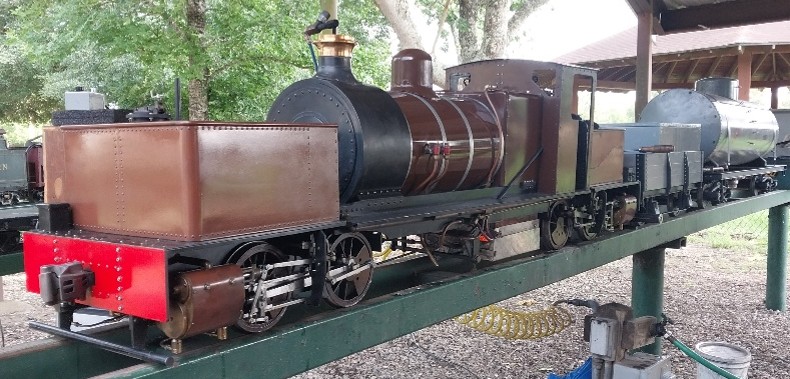
by David James
History – Prototype
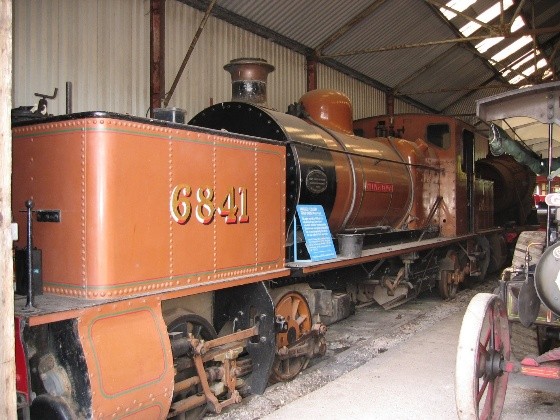
Beyer Peacock produced four 0-4-0 + 0-4-0 standard gauge Industrial Garratts between 1925 and 1937 for use in the UK. All were similar in overall design but had detailed differences. My model is based on a combination of the works drawings for the first one supplied to Vivian & Sons (Copper Manufacturers) of Swansea (works number 6172); and the final one of the four supplied to Baddesley Collieries (works number 6841) and now in the Bressingham Steam Museum, Norfolk, UK.
To give an idea of the locomotive’s capabilities the third of the four supplied to Sneyd Colliery was used to haul empty coal wagons up a 1 in 18 gradient (approximately 5.5%) with a 90-foot radius curve (Scale radius 11’ 3”).
My Locomotive
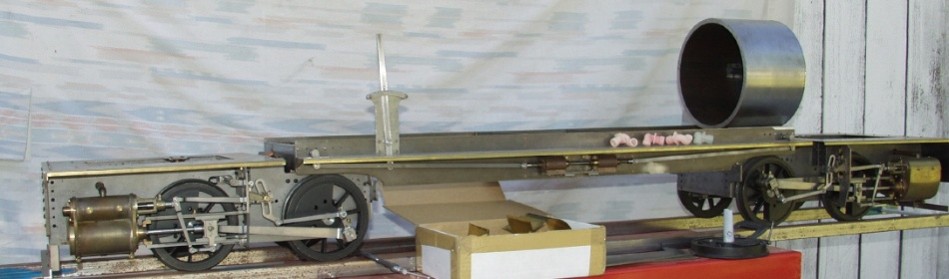
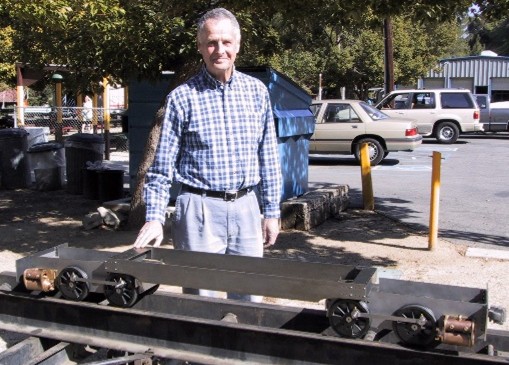
My original intention was to build the locomotive from scratch and I acquired a high resolution copy of the 1923 general arrangement drawing from the Science and Industry Museum in Manchester: however, before starting construction I found a partly built model on Discover Live Steam which I was able to purchase from the estate of Bruce Ward in 2011. As purchased the model consisted of the center boiler frame and the two completed power units which had been run on steam from a stationary boiler
In addition, there were many CAD files covering the existing construction along with layouts for most of the missing major components. To be best of my belief the locomotive was probably started around 2006, I have pictures dated 2007/2008 showing casting patterns and various stages of construction, including videos of a steam test on the power trucks.
The model differed from the prototypes in a number of respects: these included piston valves instead of slide valves, knuckle couplers in place of the British style buffers and screwlink coupling.
Completing the Locomotive
My first task was to finalize a design for the boiler, a number of possible layouts came with the model however all require a custom rolled barrel and did not have Belpaire fireboxes as fitted to the original, this was a feature that I wished to retain.
The boiler is steel with rolled in copper tubes and uses 8” nominal pipe, which although slightly over scale size, avoided the need to roll a custom barrel. The boiler was manufactured by Godshall’s Live Steam in Pennsylvania.
The front water tank, rear tank/coal bunker and cab were all fabricated from sheet steel riveted and/or bolted together. The tanks are lined with a proprietary Gas Tank sealer to protect against corrosion and seal the inevitable leaks at the seams (not entirely successful).
Pipework and swivels for the steam and exhaust connections between the central boiler unit and the two power units are of my own design based on the prototype and allow the units to pivot both horizontally and vertically to accommodate curves and undulations in the track. The joints consist of a stainless-steel ball with PTFE seals in a brass housing and an associated slip joint with a graphite yarn packing.
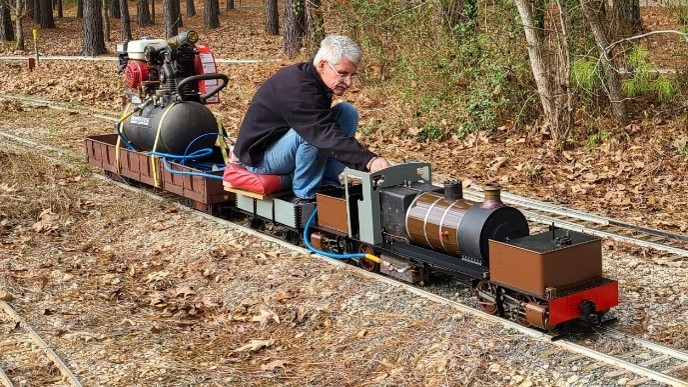
Both exhausts combine into a single blast pipe in the base of the smokebox with a sliding vertical ball joint on the front exhaust to accommodate the movement of the front power unit.
The locomotive was initially tested on air and taken to the Windy Ridge RailRoad (WRRR) for a test run in December 2021 to ensure there was sufficient movement in the power unit swivels and associated pipework.
The testing was successful and indicated that the locomotive had plenty of power. This was followed by a steam test on rollers in February 2022 before heading back to WRRR in March for testing under steam.
Name and Number
The prototype is named ‘William Francis’ after the son of the founder of the colliery and was the third locomotive to have this name. I decided I wanted to maintain the tradition of naming the locomotive but would like to remember Bruce Ward who carried out the design and initial construction of this model.
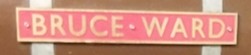
When operating under the control of a dispatcher, a locomotive number is preferred for easy identification, so I decided on #91 – my wife Angela’s birthday. Also this number did not appear to be assigned to any other locomotive within the SWLS family.
Operation
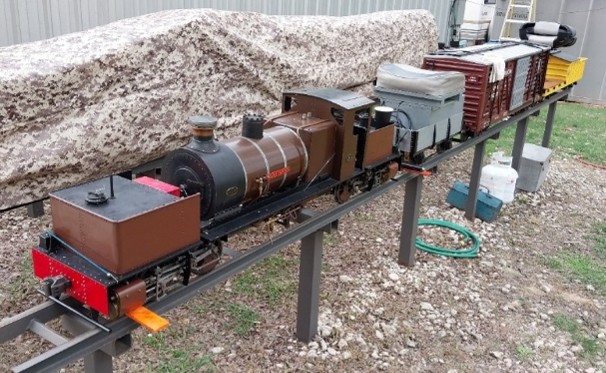
2022 through 2025 saw generally reliable operation at various SWLS tracks, LOCO and the Big Creek and Southern Railroad.
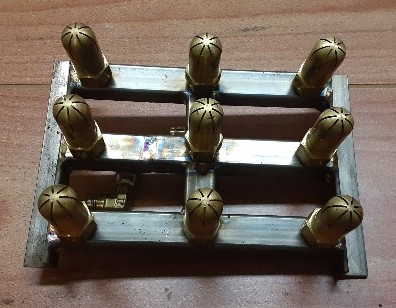
In the summer of 2025, the decision was made to convert the Garratt to propane while retaining the ability to easily convert back to coal if desired. The main drivers for this were the increasing restrictions on coal firing at various SWLS tracks and difficulty in sweeping the flues, especially when the boiler was hot: sweeping required the use of a ‘pull-through’ with one hand in the smoke box and the other in the fire box. The conversion process back to coal was proved out on the last day of the 2026 meet at Windy Ridge RR, taking roughly 1 hour from starting to lighting the charcoal and raising steam.
As with any steam locomotive there are always issues that need attention, the most significant ones so far have been:-
- Automatic cylinder drains – as designed they tended to open whenever the throttle was opened wide and the engine under load. The drains were redesigned to increase the ratio between control and cylinder pressure to prevent inadvertent opening and also to make them less susceptible to damage in the event of a derail.
- Leaky Throttle – the design uses a rotating disc with a metal to metal seal (there is no room in the smokebox for a ball valve) and tends to leak slightly when closed. A revised design using PTFE seals is in manufacture (summer 2026).
- Locomotive Brake – the design for the operating rod/levers under the boiler was copied from the 1923 drawings and prove to be very susceptible to damage in the event of a derail, it also did not compensate between the front and rear trucks, requiring precise adjustment of the linkage, typically the brakes on only one truck would do any real work. The arrangement on the last locomotive built was considerably more robust and provided compensation between the trucks allowing for much more efficient braking even with significant movement between the trucks on uneven track.
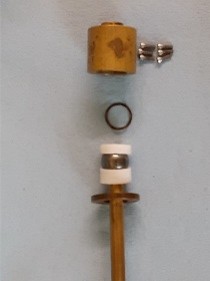
- Piston Rod Packing – the original design used O-rings for the piston rod seals which proved satisfactory for the first few years. These have now begun to leak, replacement requires the removal of the slide bars, separation of the crossheads from the piston rods and partial disassembly of the rear cylinder covers. I have decided to modify the design to use graphite yarn as an easily replaceable alternative (work in progress 2026). It should be noted that O-rings are entirely suitable for this application, but their life can be significantly shortened by high temperature and non-ideal lubrication. I estimate that the current O-rings have seen more than 1.5 million cycles, so it is not unreasonable for them to start to leak.